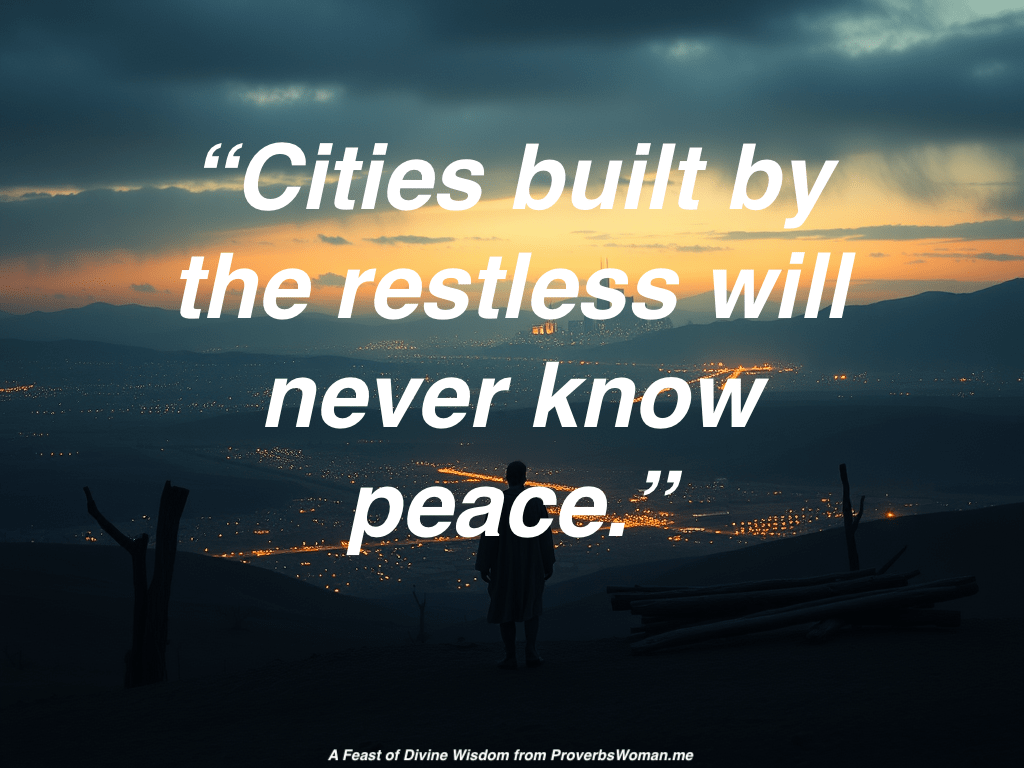
True peace cannot be found through human effort alone, especially when it is driven by restlessness, guilt, or rebellion against God.
In Genesis 4:17, Cain, after being condemned to wander for killing his brother Abel, builds a city and names it after his son, Enoch. This act appears contradictory—how can a restless wanderer establish a place of settlement? It suggests that rather than finding genuine peace, Cain is attempting to escape his judgment through the pursuit of human ambition. By constructing a city, he seeks to create a semblance of stability and control in his life, driven perhaps by a desperate need for belonging and permanence. This need is heightened by his profound sense of loss and separation from God, resulting from his heinous act. Yet, despite his efforts, they are ultimately in vain because the root of his restlessness—his alienation from the divine—is not addressed and remains unresolved.
When individuals strive to build, achieve, or establish something while carrying unresolved guilt, sin, or inner turmoil, the results are often hollow and unfulfilling. No amount of worldly success, accumulation of power, or creation of physical structures can replace the peace that can only be found through reconciliation with God. The attempts to construct an identity or legacy often lead to a cycle of disillusionment, as the foundational issues linger beneath the surface.
Moreover, this principle extends to humanity as a whole—when societies, institutions, or personal pursuits are driven by fear, ambition, or the desire to mask an inner emptiness, they may grow in size and visibility, yet they will always lack true peace and fulfillment. The pursuit of excellence, wealth, or social status, when not rooted in a harmonious relationship with God, often leads to a façade of success that ultimately does not satisfy the deeper longings of the human heart.
As these entities expand, they may appear robust from the outside, but internally, they risk becoming mere constructs held together by superficial ideals rather than genuine integrity and purpose. The weight of unresolved issues can stifle authentic growth and transformation, leading to cycles of conflict, discontent, and a quest that never truly arrives at its destination.
Thus, the lesson from Cain’s story resonates across generations, serving as a poignant reminder that true fulfillment is not found in human endeavors alone but in the reconciliation of one’s spirit with the divine. It urges individuals and communities alike to confront their inner turmoil and seek genuine peace rather than attempting to craft a false sense of security through their own means. Only through such reconciliation can lasting stability and joy be attained.
The restless roam, yet build and strive,
Stacking stone to feel alive.
But hands that labor, cursed to flee,
Can never shape true harmony.
Cain laid bricks upon the dust,
Yet in his walls, there was no trust.
For how can peace take root and grow,
Where hearts are burdened, lost in woe?
A city forged in toil and haste,
By weary souls who long to taste
A rest their striving cannot gain,
Still haunted by a mark of pain.
Ambition rises, towers climb,
Yet time will turn them into grime.
For where the restless seek to reign,
Their works are built in vain.
True peace is not in walls of stone,
Nor in a kingdom claimed alone.
But where God’s mercy finds its place,
There rests the city built by grace.






Leave a comment